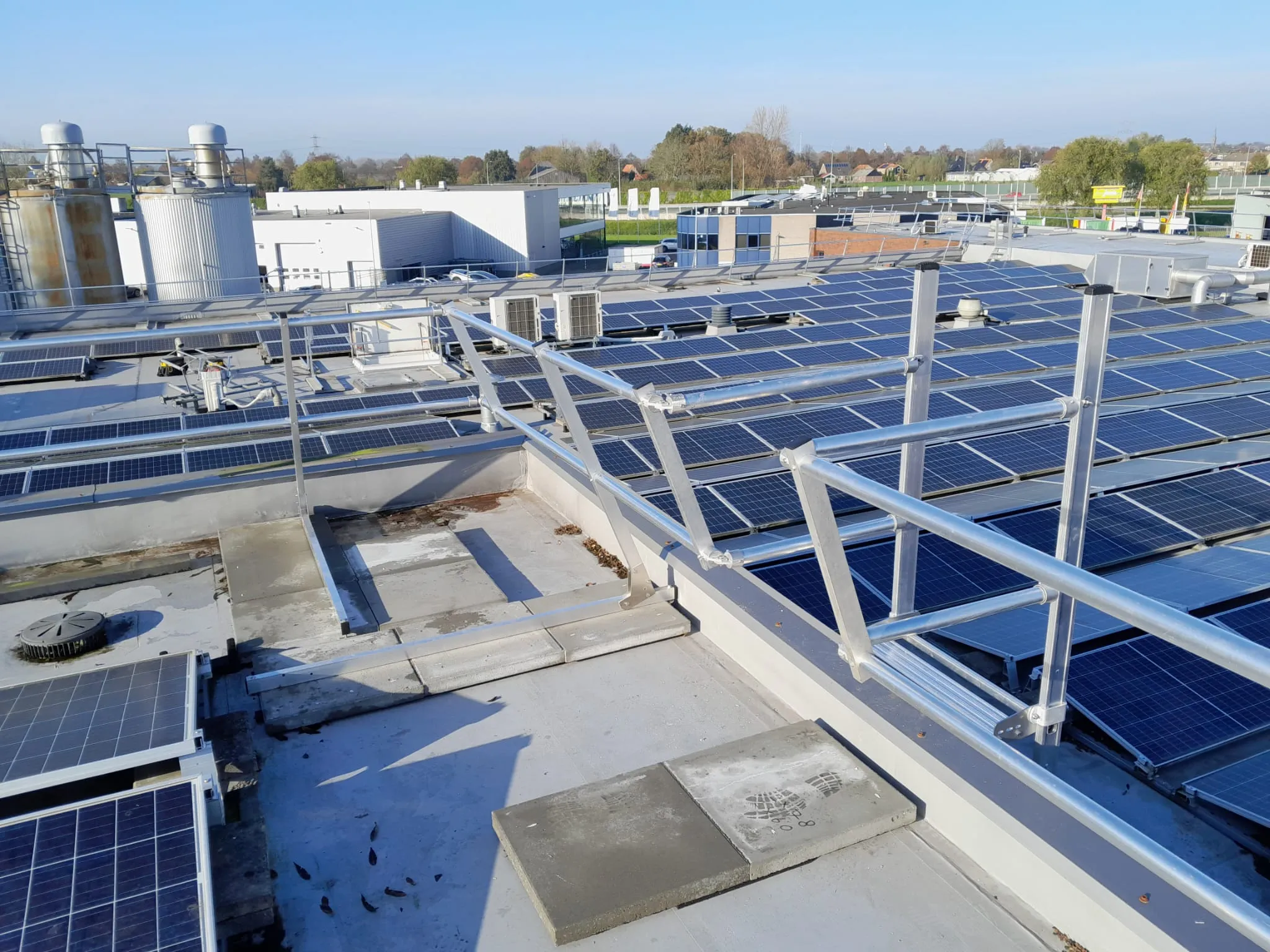
Hierarchy of controls: guardrail is mandatoryHierarchy of controls: guardrail
The Hierarchy of Controls (Directive 89/391/EEC) leaves no room for debate: permanent collective fall protection is mandatory. Where a guardrail is technically feasible, it must be installed. A harness is not an alternative — it is a mistake. Choosing a harness when a guardrail is possible means ignoring the law and bearing full liability.
One principle, all of Europe — collective before individual
The duty to protect anyone working at height is not a recent legal innovation — it is a European continuity. EU Directive 89/391/EEC establishes the hierarchy of controls: collective protection takes priority over organisational measures, which take priority over individual PPE. Every European jurisdiction transposes this into national law — EU-27, EEA, Switzerland and the United Kingdom. The wording differs; the principle does not.
- Since antiquity
Earliest recorded edge-protection law
One of the oldest surviving written legal codes already required a parapet around the roof of a new building — collective edge protection was mandated in law more than three thousand years ago.
- 1989 · EU
89/391/EEC · framework directive
Establishes the principle of collective protection above individual PPE as the foundation of EU workplace safety.
- 2001 · EU
2001/45/EC · work at height
Annex II makes permanent collective protection the first technical measure to be considered — ahead of any individual fall-arrest solution.
- Today · all of Europe
National transposition
EU-27, EEA, Switzerland and the UK each transpose 89/391/EEC and 2001/45/EC into national law — occupational-safety acts, building decrees, technical regulations. See the country reference block below for per-jurisdiction citations.
- Today
Protector Guardrail D228
Eurocode-calculated, ballasted, permanent. A permanent building feature — named after the principle it expresses.
The law has caught up. The principle has not changed.
National transposition — all of Europe
Below: the statutes in which every European jurisdiction has anchored the EU hierarchy of controls — EU-27, EEA, Switzerland and the United Kingdom. The principle is identical; the citation is local.
- ÖsterreichASchG · BauarbeiterschutzV
- België / BelgiqueCode bien-être au travail · Loi 04.08.1996 · AR 25.01.2001
- БългарияЗакон ЗБУТ · Наредба №7
- Schweiz / SuisseArG · Bauarbeitenverordnung (BauAV) · SUVA 44066
- ΚύπροςΝ. 89(I)/96 · Καν. 174/2002
- ČeskoZákon č. 309/2006 Sb. · NV č. 591/2006 Sb.
- DanmarkArbejdsmiljøloven · Bek. 1516/2010 · At-vejl. 2.4.1
- DeutschlandArbSchG · BetrSichV · ASR A2.1 · TRBS 2121
- EestiTöötervishoiu ja tööohutuse seadus
- EspañaLey 31/1995 · RD 486/1997 · RD 1627/1997
- SuomiTyöturvallisuuslaki 738/2002 · Vna 205/2009
- FranceCode du travail R.4323-58 ss · décret 2004-924
- United KingdomWork at Height Regulations 2005 (SI 2005/735) · HSG33
- ΕλλάδαΠ.Δ. 305/1996 · Ν. 3850/2010
- HrvatskaZakon o zaštiti na radu · Pravilnik NN 51/2012
- Magyarország1993. évi XCIII. tv. · 4/2002 (II. 20.) SzCsM-EüM
- IrelandSafety, Health & Welfare at Work Act 2005 · S.I. 504/2006
- ÍslandLög nr. 46/1980 · Reglur 547/1996
- ItaliaD.Lgs. 81/2008 art. 111 ss · Allegato XVIII
- LiechtensteinArbeitssicherheitsgesetz · BauAV
- LietuvaDarbuotojų saugos įst. · STR 1.07.01:2010
- LuxembourgCode du travail livre III · Rgd 01.09.2006
- LatvijaDarba aizsardzības likums · MK not. Nr. 92
- MaltaOHS Authority Act · LN 281/2004
- NederlandArbobesluit art. 3.16 · Bbl 4.7.11 / 3.5
- NorgeArbeidsmiljøloven · FOR-2011-12-06-1357
- PolskaKodeks pracy · Rozp. MPiPS 26.09.1997
- PortugalLei n.º 102/2009 · DL n.º 50/2005
- RomâniaLegea 319/2006 · HG 1051/2006
- SverigeArbetsmiljölagen · AFS 1981:14 · AFS 1999:3
- SlovenijaZVZD-1 · Uredba o varnostnih ukrepih
- SlovenskoZákon č. 124/2006 Z.z. · Vyhl. č. 147/2013 Z.z.
The references listed are indicative and reflect the principal statutes in which the EU hierarchy of controls is anchored at the time of publication in each European country — EU-27 member states, EEA countries (Norway, Iceland, Liechtenstein), Switzerland and the United Kingdom (Work at Height Regulations 2005, which continues to transpose 2001/45/EC). For specific compliance and liability purposes we recommend consulting the current source text and local legal counsel.
Safety hierarchy is legally binding
Under occupational-safety legislation and EU Directive 89/391/EEC, protection measures must be assessed in this fixed order. Deviation requires documented justification.
Hierarchy of controls
Requirement: Collective protection (technical measures) takes priority over personal protective equipment.
Legal compliance: ✓ Correct. Technical collective measures rank above PPE — this is the statutory order.
Temporary standard
Requirement: EN 13374:2025 applies to temporary edge protection during the construction phase.
Legal compliance: ✓ Correct. This standard applies specifically to the construction phase or short-term use.
Max. service life (temp.)
Requirement: Temporary systems may be deployed for a maximum of 6 months.
Legal compliance: ✓ Correct. After 6 months they no longer qualify as a normative solution for the maintenance phase.
Wind load (temporary)
Requirement: Limited capacity (approx. Beaufort 6); dismantling required at higher wind speeds.
Legal compliance: ✓ Correct. Without a project-specific structural calculation, temporary systems are not stable in storm conditions.
Permanent standard
Requirement: Eurocode 1 with wind-load calculation required for permanent safety systems.
Legal compliance: ✓ Correct. Mandatory for the permanent use and maintenance phase.
Liability risk
Requirement: Deploying temporary systems instead of permanent solutions creates legal liability exposure.
Legal compliance: ✓ Correct. Risk assessment always requires the safest technically feasible measure.