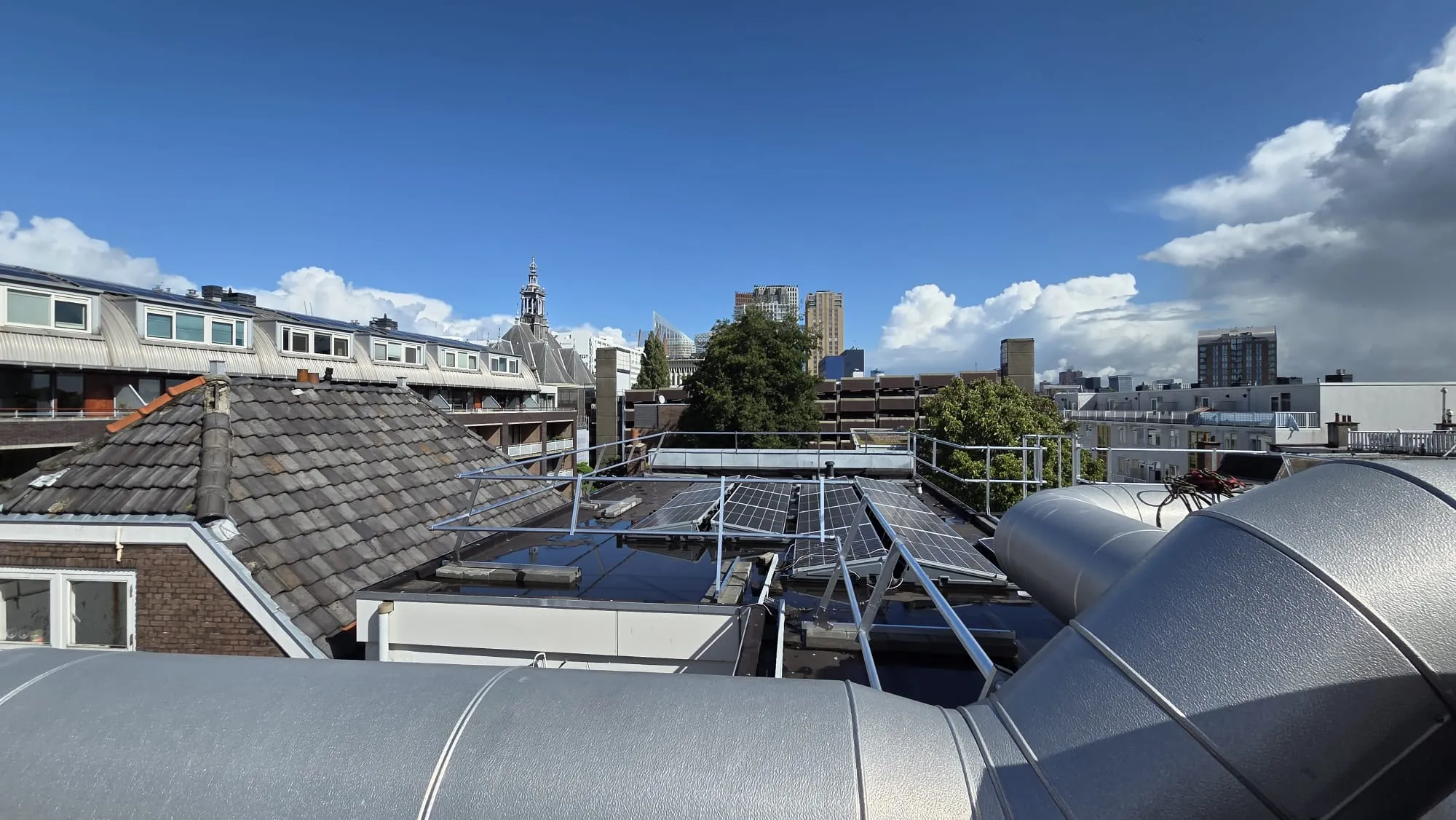
Flat roof edge protection permanent, without penetrationpermanent guardrail
Edge protection for a flat roof does not have to penetrate the roof membrane. Protector Guardrail is a permanent, collective roof guardrail that stands on ballast and so provides continuous fall protection along the full roof edge. Installed once, safe forever — for maintenance, installations and inspections.
Why a flat roof requires edge protection
A flat roof is rarely a roof you complete once and then forget. Roofers, solar-panel installers, HVAC technicians and inspectors enter the roof regularly. On each of those visits there is a fall hazard at the unprotected roof edge — and therefore a legal duty to remove that hazard at source. Does your building have a different roof type? See the applications by roof and sector.
The hierarchy of controls sets the order: first eliminate the hazard, then collective protection, and only as a last resort personal protective equipment. Fall protection on a flat roof therefore begins with a collective provision such as a guardrail, not with a harness. Where a permanent guardrail can technically be installed, that is the standard — and it is not optional.
If you nonetheless rely solely on personal equipment while a guardrail is feasible, you depart from the law and the liability shifts entirely to you. The background to that duty is set out on the safety hierarchy page.
Ballast instead of penetration
Most damage to a flat roof is caused not by the weather, but by what we fix into it. Every penetration of the roof membrane is a potential leak point and can void the membrane warranty. Protector Guardrail solves that by not drilling at all.
The guardrail sits on a ballast base and stays in place through weight. The membrane runs on undamaged beneath the system; there are no penetrations and no fixings that compromise it. The required ballast weight follows from a project-specific Eurocode calculation based on wind zone, roof height and terrain roughness, so the system stays stable even under peak wind load.
Edge protection thus becomes a permanent, integrated building element instead of a temporary intervention that damages the roof. The full technical build-up and specifications are on the system page.
Eurocode calculation for the flat roof
A ballasted system stands or falls on its weight. Too light and the guardrail shifts under wind load; too heavy and you burden the roof needlessly. That weight cannot be settled with a rule of thumb — it follows from the Eurocode (EN 1991-1-4), the European standard for wind loading on structures.
That is why every delivery includes a project-specific structural calculation to that Eurocode, working through the local peak velocity pressure, the wind zone, the roof height and the terrain roughness, plus a Declaration of Performance (DoP). The required ballast weight is then not assumed, but demonstrably calculated for the specific roof the guardrail will stand on.
Working safely on a flat roof: permanent or temporary
Edge protection for a flat roof can be temporary or permanent. The difference is not only price, but above all who is protected the moment someone has to go onto the roof unannounced.
| Temporary edge protection | Permanent guardrail | |
|---|---|---|
| Protected when | Temporary edge protection: Only during the planned work | Permanent guardrail: Always — including an unannounced roof visit |
| Action per roof visit | Temporary edge protection: Install, then remove afterwards | Permanent guardrail: None: the roof edge is already secured |
| Roof membrane | Temporary edge protection: Often clamped or fixed to the roof edge | Permanent guardrail: Ballast, so no penetration |
| Wind calculation | Temporary edge protection: Reassessed for every set-up | Permanent guardrail: Once, project-specific, to Eurocode |
| Cost | Temporary edge protection: Recurring, per deployment | Permanent guardrail: One-off, per linear metre of roof edge |
For a roof that is entered periodically — virtually every flat roof — that makes a permanent solution both safer and cheaper over its lifetime. Completed installations are shown in the references.
Frequently asked questions about flat roof edge protection
1Is edge protection mandatory on a flat roof?
2Does the flat roof need to be penetrated for installation?
3What is flat roof edge protection calculated against?
4Permanent guardrail or temporary edge protection — which is better?
5What does flat roof edge protection cost?
Ready to protect your flat roof permanently?
Request advice with no obligation, or work out an indication straight away with the online calculator.